María Dyada
Pedro PáramoMaría Dyada is remembered as a poor woman who came to Father Rentería seeking spiritual help for her sister, Eduviges Dyada. Her appeal brings the sisters’ history of generosity and exploitation into the priest’s troubled conscience: María argues that Eduviges’s suicide followed a life of kindness and ended in extreme suffering, while the Church’s promised aid is constrained by money she does not have.
Identity and Appearance in the Narrative
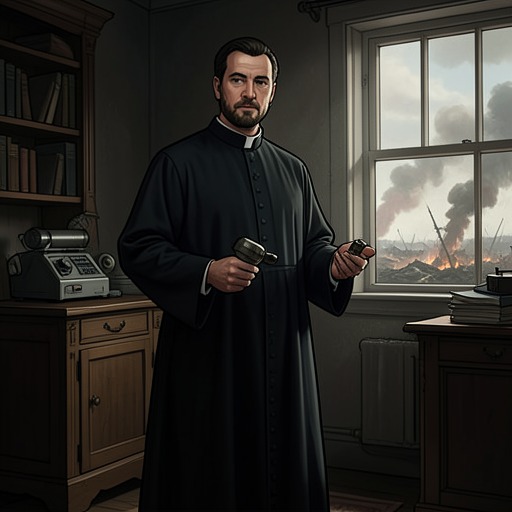
María is not presented through an independent scene. She enters the novel in Father Rentería’s sleepless recollection, as the woman who once came to him to ask that he save Eduviges. The memory returns while he blames himself for betraying people who trusted him, making María’s visit both a specific plea and a measure of the harm his choices have caused.
Rentería remembers her as a poor woman burdened with children. The passage gives no further account of her life, but her poverty is decisive in the encounter: when the priest raises the possibility of more elaborate masses, she cannot pay for them.
Eduviges’s Kindness and Its Cost
In María’s account, Eduviges had continually helped others and given away everything she possessed. She had also borne children for men who would not acknowledge them. When they refused to recognize the children she presented to them, Eduviges said that she was their father as well as their mother, though chance had made her the mother. María’s report presents this not as a cause for condemnation but as evidence of how others took advantage of her hospitality and her reluctance to offend or quarrel with anyone.
That history shapes María’s defense of her sister after Eduviges’s suicide. Father Rentería had told María that Eduviges had acted against God’s will and failed at the final hour, putting at risk the good works she had accumulated. María counters that her sister had no other way out and that the same kindness that marked her life also lay behind her decision. Her plea thus asks the priest to reckon with the circumstances and suffering behind the act, not only with its religious prohibition.
The Plea for Mercy and the Price of Ritual
María recalls Eduviges dying in great pain, twisting in the blood that suffocated her; she says the woman’s grimaces were the saddest she had ever seen. The physical detail gives María’s argument its force: her sister’s last suffering is not an abstraction to be settled by a rule about sin. María also reminds the priest that they pray often, resisting his suggestion that prayer might still help as though the family had not already turned to it.
Rentería proposes that high masses might be needed, with a deacon and subdeacon, but acknowledges that arranging them would cost money. María answers plainly that she has none and that he knows it. His response is to leave matters as they are and entrust them to God; María agrees. The exchange exposes the distance between the spiritual remedy the priest names and the material means required to obtain it. Her poverty leaves her with prayer and resignation where a richer petitioner might have been offered a more elaborate rite.
Memory and Significance
Long after the visit, Rentería can still see María’s gaze before him. In his private reckoning, that remembered face stands beside his own fear that he has offended those who sustain him and betrayed those who trusted him to intercede for them. María’s appeal therefore persists beyond its immediate failure to secure help: it becomes part of the evidence he cannot quiet in himself.
The novel offers no resolution to María’s request and no later account of her fate. What remains is the contrast between her insistence on Eduviges’s generous life and painful death, the priest’s judgment of suicide, and a religious remedy whose proposed cost is beyond the family’s reach. María’s brief appearance gives the dead woman’s history a voice and makes poverty, moral judgment, and clerical responsibility converge in one remembered encounter.